

Termites are quiet. They don’t make much noise, and they rarely show themselves until the damage is done. That’s why so many Melbourne homeowners only find out about a problem when a skirting board crumbles under a finger or a door suddenly won’t close. The good news is that your home usually gives you a few hints first. If you know what to look for, you can act early and save a lot of money and stress. In this post, we’ll go through the most common signs that your property may need termite chemical barrier treatment, and what to do next.
What a termite barrier actually does

Termites live underground and travel through the soil to reach the timber in your house. A chemical barrier is a treated zone of soil around and under your home. When termites cross it, they pick up the chemical and carry it back to the nest. Products like Termidor are non-repellent, which means termites can’t detect them. The chemical spreads through the colony when they groom and feed each other.
At Melbourne Termite Control, we install barriers to Australian Standard AS3660 and give you a Certificate of Treatment when the job is done. That certificate matters for insurance and for selling your home later. This is the idea behind termite chemical barrier treatment. It protects the house from the ground up, instead of only dealing with the termites you can see.
Mud tubes on walls, stumps or slab edges
Mud tubes are the clearest warning sign. They’re thin, pencil-sized tunnels made of soil and saliva, and termites build them to travel safely from the ground to your timber. You’ll often spot them on brick walls, timber stumps, concrete edges and inside the subfloor.
If you find one, don’t knock it down and walk away. Termites will often rebuild it or use another path. Take a photo, leave it as it is and book an inspection. A technician can tell you whether the tubes are active and where the colony may be coming from.
Timber that sounds hollow
Termites eat timber from the inside out. The outer layer often looks fine, so the damage stays hidden for a long time. A simple test is to tap skirting boards, door frames and window frames with the handle of a screwdriver. Solid timber gives a sharp sound. Timber that has been eaten sounds dull or papery.
You might also notice paint that looks bubbly or wavy, or a floorboard that feels soft when you step on it. These can be signs of moisture, but they can also point to termites. It’s worth getting both checked.
Doors and windows that start sticking
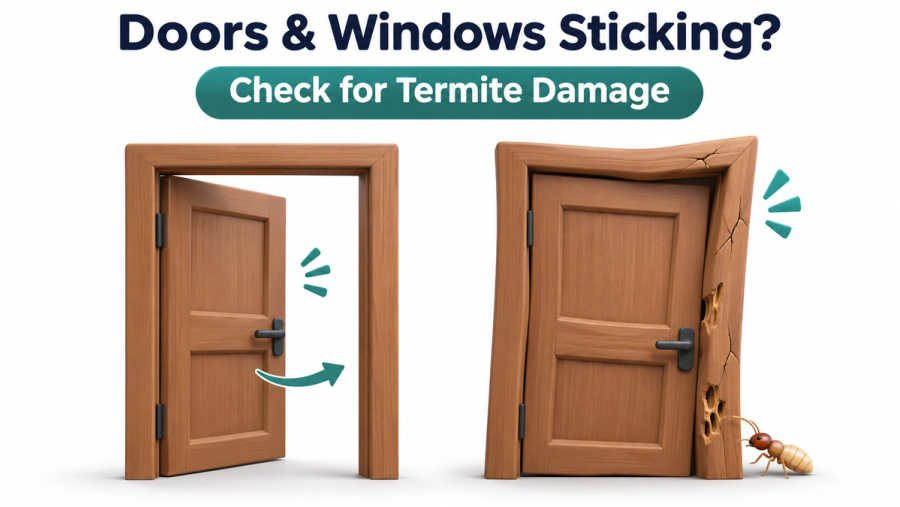
Has a door or window suddenly become hard to open or close? Most people blame the weather, and sometimes that’s true. But termites can make frames swell or warp as they feed and as moisture builds up around them. If the problem appears for no clear reason, or it’s happening in more than one spot, take it seriously.
Piles of fine dust and discarded wings
Small heaps of what looks like sawdust near skirting boards or window sills can mean termites are pushing waste out of the timber. Another clue is a pile of thin, see-through wings near a window or light. Termites shed their wings after a swarm, and a swarm usually means a mature colony is nearby.
In Victoria, swarms tend to happen in the warmer months. If you see flying insects inside your home in spring or summer, don’t assume they’re harmless.
Your property has higher-risk conditions
Some homes are simply easier for termites to reach. You may be more at risk if you have:
- Garden beds or mulch piled against the walls
- Timber retaining walls or old tree stumps close to the house
- Leaking taps, downpipes or pipes that keep the soil damp
- Clay soil that holds moisture
- Cracks in the slab or gaps around pipes
You don’t need to see termites to have a risk. Many people choose termite chemical barrier treatment because their property ticks several of these boxes, and they’d rather be safe than sorry.
Your old barrier is wearing out
A barrier doesn’t last forever. Termidor can protect a home for up to 8 years in normal conditions, and Biflex usually lasts 5 to 8 years. Rain, soil movement, landscaping and building work can all weaken the treated zone over time.
If your home had a barrier put in years ago, check the date on your paperwork. If you don’t have any paperwork, that’s a sign too. Annual inspections also matter, because most warranties need them to stay valid. When the protection is close to running out, a fresh termite chemical barrier treatment is far cheaper than repairing a damaged frame. If you have a reticulation system, your technician can top it up without digging up your garden.
You bought an older home with no records
Plenty of buyers move into a house without knowing if it was ever treated. Maybe the previous owner didn’t keep records, or the inspection was never done. If you don’t know the history, assume the home isn’t protected until someone checks. A pre-purchase or first-time inspection will show whether there’s any activity and whether a barrier is already in place.
New homes need care too. Builders must install a termite system under the National Construction Code, but it still needs regular inspections. Physical barriers can have weak spots around pipes and joints, and some owners add a chemical layer for extra peace of mind.
Why DIY sprays aren’t enough

It’s tempting to grab a can from the hardware store when you see a few termites. We understand that. The problem is that many shop products repel termites instead of killing the colony. The termites simply move a metre along the wall and find another way in. Meanwhile, you think the problem is solved.
A professional termite chemical barrier treatment uses commercial-grade products at the right rate and depth. It also covers hard-to-reach areas, such as the soil under concrete paths and slabs. We drill small holes, inject the product and seal them again, so there are no gaps for termites to slip through.
Why homeowners choose Melbourne Termite Control
Melbourne Termite Control is a local, licensed and fully insured team that has helped homeowners across Greater Melbourne for years. With over 1,800 verified Google reviews and a 5.0 rating, our customers trust us because we explain things in plain English and never push work you don’t need.
Every job follows Australian Standard AS3660, and we are accredited Termidor applicators. That means your home may be eligible for the Termidor Assurance Warranty. We give fixed-price quotes, offer same-day bookings in many areas and always hand over a Certificate of Treatment. Whether you live in the CBD, Werribee, Box Hill or Frankston, Melbourne Termite Control can inspect your home and give you honest advice.
What happens when you call us
We keep the process simple, and we explain each step in plain English.
- A licensed technician inspects your property and checks for activity, soil type and entry points.
- We write up a treatment plan and give you a fixed-price quote.
- We prepare the area, which may include trenching and drilling.
- We apply the product around and under the building.
- You get your Certificate of Treatment, and we remind you about annual inspections.
Book an inspection before it gets worse
If you’ve noticed any of the signs above, don’t wait for them to get worse. Termites work around the clock, and a small problem can turn into a big one within months. Even if you haven’t seen anything, an inspection every year is a smart habit for any Melbourne home.
Melbourne Termite Control is a local team with licensed technicians, fixed-price quotes and same-day bookings in many areas.
Call us on 04 3430 0216 or book a free assessment online. If your home needs termite chemical barrier treatment, we’ll tell you plainly, and if it doesn’t, we’ll tell you that too.
Need Professional Termite Control?
Don't let termites eat away at your home. Get expert termite inspections and treatments from Melbourne's trusted specialists.
Book Your Service Now
Tell us what you need and we'll call you back to confirm a time. No obligation.
Don't Wait — Act Today
Melbourne homes face one of Australia's highest termite risks — and the structural damage they cause is not covered by home insurance. Whether you have spotted a warning sign or simply want peace of mind, our licensed Melbourne termite specialists are ready to help. Book a same-day or next-day inspection and receive a written report with clear options — no pressure, no jargon, no surprises.
Available Monday – Saturday: 7:00 AM – 7:00 PM | Emergency inspections available on Sundays